Convert to Excel online. Photos of tables, screenshots and scanned pages become XLSX or XLS spreadsheets, with nothing to install and no account needed.
or drop, paste, or choose from cloud





A screenshot of a table is one flat image. You cannot sort it, total it, or correct a figure in it. The converter reads the characters and writes them into real spreadsheet cells.
Pick Microsoft Excel (*.xlsx) for current versions of Excel, or Excel 2003 or earlier (*.xls) when the file has to open on an old machine. The choice sits next to the uploader.
Converting an image to Excel is free, costs no credits and works without signing up. Add several files at once and each one comes back as its own spreadsheet.
A photographed table and a scanned page hold no text at all. They hold pixels that look like text. Optical character recognition, or OCR, is the step that reads those pixels and turns them back into numbers and words.
That is what separates this from a plain spreadsheet export. An export can only move text that is already there. OCR has to build the text first, which is why a photo of a printed report can become a spreadsheet at all.
It also sets the limits, and it is worth being straight about them. The flatter and cleaner the page, the closer the result is to the original table. A steep angle, a shadow across the paper, or a faint print all cost accuracy, and no converter avoids that.
JPG is the format people ask about most and it is not the only one that works. PNG, GIF, and TIF images convert the same way, and JPEG is simply the same format written with a longer extension.
A screenshot is just an image, so a table copied out of a dashboard, a slide, or a web page is handled like any other picture. A document made from a scan works too, page by page.
What is inside the file matters far more than the extension. A printed table with clear text and a straight edge converts best, whichever way it arrived.
These files contain spreadsheet data. They are often used to create and share worksheets, charts, calculations, tables, and macros.
XLSX is the current format and the one to choose unless something stops you. It uses the Open XML standard that Microsoft Office 2007 introduced, and every modern spreadsheet program reads it, including Google Sheets, LibreOffice Calc, and Apple Numbers.
XLS is the older binary format. Choose it when the file has to open in Excel 2003 or in a program that never learned to read XLSX.
File extensions: .xlsx and .xls. MIME type: application/vnd.openxmlformats-officedocument.spreadsheetml.sheet
Converting an image to Excel is free and needs no account. Add several files and they convert in one go, each returned as its own spreadsheet.
Every upload and download runs over an encrypted connection, so your pages cannot be read on the way. Processing is fully automated: nobody looks at your files and they are never used to train AI models.
You keep the copyright and the ownership of both the file you upload and the spreadsheet you get back, and the servers that do the work are in Europe.
The result is only ever as good as the table in the picture. This is what to expect before you upload.
| What you upload | How well it converts | What to do |
|---|---|---|
| A clean scan of a printed table | Very well. Rows and columns land close to where they were | Nothing. Upload it as it is |
| A screenshot of a table | Very well. The text is sharp and the grid lines are clear | Crop to the table before you upload |
| A phone photo of a page on a desk | Well when the page is flat, evenly lit, and shot straight on | Retake it from directly above if the first result is messy |
| A table with merged cells, color blocks, or stacked headers | Partly. The values arrive, the structure often does not | Plan to rebuild the header rows by hand |
| Handwriting, or a blurred or angled photo | Poorly. Text recognition reads printed characters, not handwriting | Type those values in, or scan the page again |
| A page with no table on it | It converts, and you get a sheet of loose text | Use the image to text app instead for plain text |
Uploads are limited to 100 MB without an account. A conversion that comes back empty usually points at the source: a password-protected or damaged original, or a picture with no readable text in it.
Most of the demand is one job: getting a table that only exists as a picture back into cells.
A photographed receipt or a scanned invoice becomes a row of figures you can total, file and hand to an accounting sheet.
Annual reports, price lists, and account statements often exist only on paper or as a scan. Converting one is quicker than typing the numbers again.
A table copied out of a slide deck, a dashboard, or a web page arrives as an image. Converting it puts the values back where you can use them.
Upload your image or scan. It can be a PNG, JPG, another image file, or a PDF document.
Choose the format you need (XLS or XLSX).
Click "Start" and wait for your Excel spreadsheet to be created.
Download the spreadsheet and open it in Excel, Google Sheets, LibreOffice Calc, or Apple Numbers.
Upload the picture, choose Microsoft Excel (*.xlsx) or Excel 2003 or earlier (*.xls), and press Start. The characters in the image are read and written into spreadsheet cells, and the file downloads when it is ready.
Yes. Converting an image to Excel is free, needs no account and costs no credits. Paid plans exist for very large files, longer batches and priority processing, and an ordinary conversion does not need one.
JPG, JPEG, PNG, GIF and TIF all convert, a screenshot is just an image so it works the same way as a photo, and a scanned page or a PDF is accepted as well. What matters is that the table is legible, not which format it arrived in.
Yes, and the photo decides the result. Shoot the page flat, from directly above, in even light, with the whole table in frame. A steep angle, a shadow, or a blurred shot all cost accuracy.
A plain grid of printed cells usually comes across intact. Merged cells, stacked headers, and color blocks are harder: the values arrive, the structure often needs rebuilding by hand. Check the sheet before you use the numbers.
Microsoft Excel does have a Data From Picture feature, but only on some versions and platforms, so it is not there for everyone. This converter runs in any browser, needs no install and no account, and gives you an XLSX or XLS file any spreadsheet program can open.
The usual cause is a source that cannot be read: a password-protected or damaged original, or a picture with no readable text in it. Uploads are also limited to 100 MB without an account. Try a sharper copy of the same page, or crop the picture down to the table.
Yes. The connection is encrypted in both directions, so nobody can read the file while it travels. Processing is fully automated, so no person opens your pages, and files are never used to train AI models. The rights to the image and to the spreadsheet stay with you.
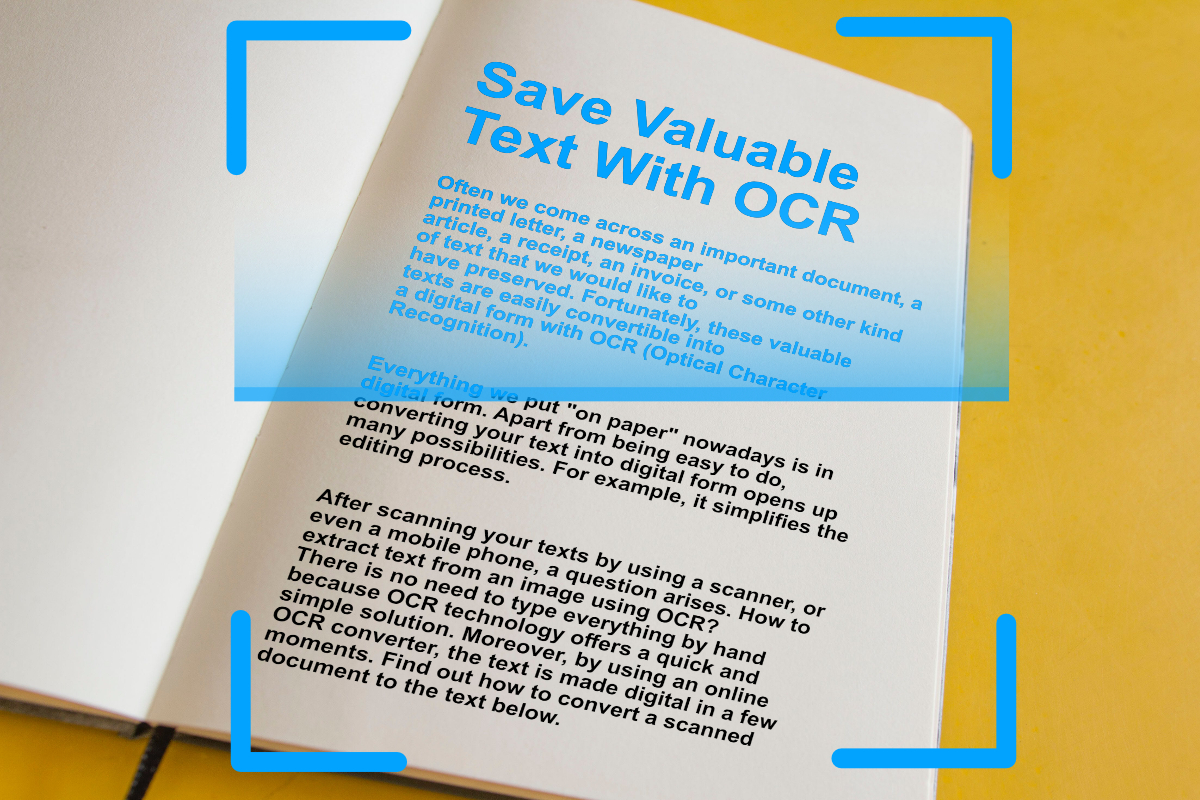
Digitize important text from scanned documents and images with OCR (Optical Character Recognition). Extract text from images easily, online.
Read article